
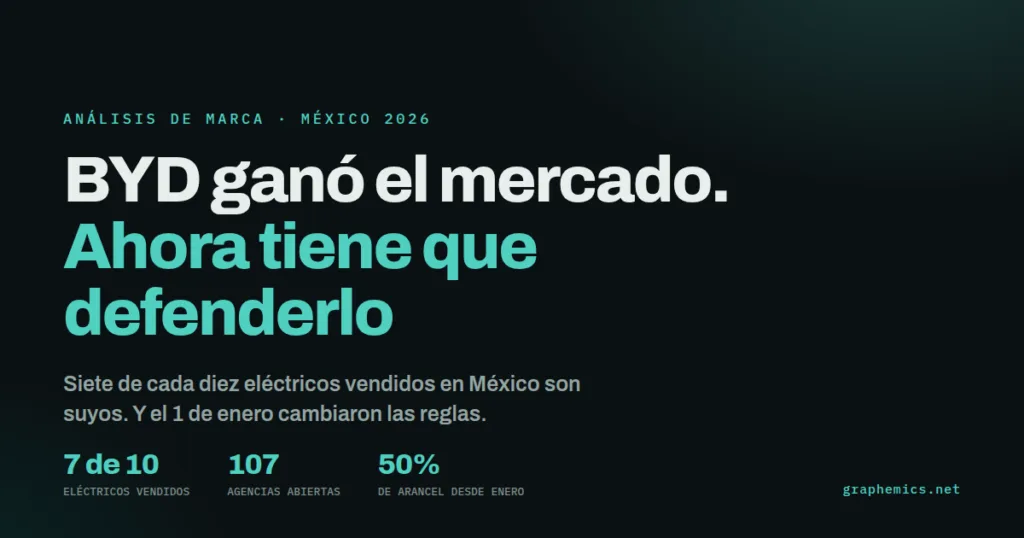
BYD entered Mexico recently and is already the country’s eighth best-selling brand, ahead of manufacturers with fifty years of local presence. It closed 2025 with about 75.000 units sold and has around 120.000 vehicles on the road.
In its segment it doesn’t compete—it dominates. Seven out of ten electric and plug-in hybrids sold in the country are theirs, with 4% of the total auto market.
Adoption isn’t in doubt. The reason is surprising
The main driver of success isn’t technology. It’s financing.
While Mexico’s auto market typically finances between 13% and 14%, BYD offers plans starting at 7,9%. With 65% of its units sold on credit, that six-point gap is, in practice, its strongest selling proposition.
Mexican buyers weren’t sold an electric car. They were sold a lower monthly payment that happens to be for an electric car.
What changed on January 1, 2026
The Mexican government imposed a 50% tariff on imports of vehicles from China and other countries without a trade agreement. Electric vehicles fall under tariff line 8703.80.01.
The impact is already measurable: imports of Chinese light vehicles fell 31,1% in the first half. But the hit hasn’t reached the consumer yet, for a specific reason: during 2025, 217.838 units were brought forward into Mexico and are being sold this year without paying the new levy.
That cushion is running out. Once it’s gone, prices go up — and the cheap-credit argument that underpins the brand narrows.
Why that defines where the opportunity is
BYD’s 2026 strategy has a name: its Mexico CEO, Jorge Vallejo, called it the Consolidation phase. It’s not aggressive expansion; it’s locking in gains with tighter margins.
In practical terms: this year BYD doesn’t need to sell more one-off cars; it needs to sell better. Predictable volume, repeat customers, and markets where the cost of opening pays back fast.
Where it is today—and where it isn’t
The 107 dealerships are heavily clustered. Ten states take the lion’s share: Ciudad de México (15), Estado de México (11), Jalisco (7), Nuevo León (7), Guanajuato (6), Sinaloa (5), Veracruz (5), Coahuila (4), Michoacán (4) y Puebla (4).
The pattern is clear: BYD seeded the industrial center and the north, where manufacturing and traditional purchasing power sit. The tourist southeast was left for later.
And there’s a sign they already know it: they just opened in Los Cabos, a market they acknowledged as pending in their national coverage. Los Cabos isn’t an industrial city; it’s high-spend tourism. That move signals where they’re looking.
The three markets with the most runway
Ranked not by population, but by where an EV pays for itself faster.
1. Cancún y la Riviera Maya
This is the clearest opportunity in the country—and not with individuals: with rental car fleets. Quintana Roo concentrates one of the largest rental fleets in Latin America, with vehicles racking up intensive mileage on short, repeatable routes — the exact profile where an EV beats gasoline, because the fuel savings show up daily, not yearly.
Add that international tourists arriving there already expect to find electric cars, because they rent them in their home countries.
The catch—and it’s worth stating: Quintana Roo trails states like Guanajuato in the number of charging stations. That raises entry costs — but for a fleet with its own base, charging is handled in the company lot, not on the street.
2. Mérida y la península de Yucatán
It’s the fastest-growing upper–middle-class city in the southeast, with steady in-migration from the country’s center. And it has something no other Mexican market has: a fully operating electric transit system, Ie-Tram, which normalizes electromobility for everyday residents before they even consider buying.
When someone already rides an electric vehicle every day, buying one stops being a rarity.
3. Querétaro
The surprise in the 2026 data: Querétaro surpassed Veracruz, Yucatán, and Coahuila in EV and hybrid volume—states with a longer automotive track record. An industrial corridor, a young professional class, and short distances between cities.
Less romantic than the southeast, but with less risk: here, demand is proven, not projected.
The pitch that opens doors: fleets, not individuals
BYD closed 2025 with about 10.200 units sold to fleets, 14% of its volume, and its stated goal is to increase that share by 25% this year. It’s the only business line where the brand has publicly said it wants to grow.
And it fits the tariff backdrop: when prices rise, the individual buyer hesitates, but a company that calculates cost per kilometer doesn’t — it does the math and it still works. Fleet buyers are the clients who can absorb a price increase without walking away.
What doesn’t line up in the numbers
Two discrepancies across sources, stated upfront instead of picking the one that sounds better:
- 2025 sales: some sources say 75.000 units and others 85.000. The gap is likely whether they count only BYD or also its sister brands Denza and Yangwang.
- Dealer network: it shows up as 100 and as 107 depending on the report date. The network is growing, so both can be correct at the time.
Neither changes the conclusion, but if someone is going to use a number in a negotiation, it’s worth getting it from the source.
In one sentence
BYD doesn’t have an adoption problem in Mexico; it has a margin problem and an incomplete map. The brand has already convinced the buyer; what’s missing is being where an EV delivers the most per peso invested. That place, today, is the tourist southeast, and the entry point is fleets.
Sources
- BYD México coloca 75 mil autos en 2025 e inicia la fase Consolidación 2026 — Negocio Motor
- BYD vende 7 de cada 10 autos eléctricos en México — El Financiero
- BYD planea duplicar su venta de flotillas en México — Expansión
- Los aranceles reducen un 31% la importación de autos chinos — La Silla Rota
- Con BYD, la electromovilidad gana terreno en Los Cabos — Excélsior
- Querétaro escala en venta de eléctricos e híbridos en 2026 — Líder Empresarial
Year-end 2025 and first-half 2026 figures, per each source. This document is market analysis, not investment advice or an official brand report.
Versión en español: BYD en México 2026: aceptación, aranceles y dónde queda espacio para crecer